

Best LED Lighting for Commercial Offices
Table of Contents
- Understanding Color Temperature for Office Productivity
- Office Lighting Lumen Requirements and Foot-Candle Standards
-
Top LED Lighting Fixtures for Commercial Offices
- 1. Alberta LED Lights & Electrical Supplies, Complete Commercial LED Solutions
- 2. LEDCO LED Panel Lights, Best for Suspended Ceiling Retrofits
- 3. Votatec 2x4 LED Troffer, Best for Flexible, Glare-Controlled Lighting
- 4. Satco 65-1665 2x4 White LED Panel, Best for Energy Rebates and Efficiency
- 5. Cree Lighting Indoor Troffers, Best for Smart Controls and Long Lifespan
- 6. Polarix Advanced LED Panels, Best for High Efficiency and Flicker-Free Lighting
- 7. Liteline STRIPE Linear System, Best for Modern Open-Plan Offices
- Key Features to Evaluate When Choosing Office LED Lighting
- Commercial LED Lighting Return Policy and Warranty Considerations
- Installation and Retrofit Options for Office Spaces
- Energy Efficiency and Cost Savings with LED Office Lighting
- Conclusion
- Frequently Asked Questions
Last Updated: September 3, 2026
Understanding Color Temperature for Office Productivity
The color temperature of your office lighting directly affects how alert, focused, and productive your team feels throughout the day. Measured in Kelvin (K), color temperature ranges from warm yellows (2700K) to cool blues (6500K), and choosing the right one is fundamental to selecting the best LED lighting for commercial offices.
For most office environments, 4000K (cool white) or 5000K (daylight white) delivers the ideal balance. These color temperatures promote alertness and concentration without the harshness of extreme cool tones. At 4000K, you get a neutral white that feels professional and supports sustained attention, ideal for general office work, meetings, and administrative tasks. At 5000K, the light mimics natural daylight, which naturally enhances focus and reduces eye strain during long work hours.
The Science of Light and Circadian Rhythm
The science here goes deeper than simple alertness. Your eyes contain specialized photoreceptors called intrinsically photosensitive retinal ganglion cells (ipRGCs) that are most sensitive to blue light wavelengths around 460-480 nanometers (peer-reviewed research). These cells do not primarily control vision; instead, they regulate your circadian rhythm, the internal 24-hour cycle that governs sleep-wake timing, hormone production, body temperature, and metabolic function.
When you expose your eyes to cooler color temperatures (above 4000K) during morning and midday hours, you trigger these photoreceptors, signaling your brain to suppress melatonin production and maintain alertness. This is why 5000K works especially well in the morning and early afternoon: it aligns with the natural light spectrum your body expects at those times, reinforcing a healthy circadian rhythm.
Conversely, exposure to warm color temperatures (3000K or below) in the evening signals your body that it's time to wind down. If your office uses 5000K lighting until 6 PM and employees then go home to warm-toned home lighting, the transition supports natural melatonin production and sleep onset. However, if your office uses warm lighting all day, employees may experience afternoon energy dips and difficulty falling asleep at night, even if they feel comfortable in the moment.
This is the foundation of Human-Centric Lighting (HCL), a design approach that uses dynamic or strategically layered color temperatures to support the body's natural circadian rhythm rather than fighting it.
Implementing Human-Centric Lighting in Commercial Offices
HCL does not require expensive dynamic color-changing systems. A practical approach uses fixed color temperatures strategically:
- Morning and task-intensive zones (6 AM-3 PM): 5000K (daylight white) to maximize circadian stimulation and alertness. This is ideal for design studios, data entry, quality control, and any role requiring sustained focus.
- Afternoon and general office areas (3 PM-6 PM): 4000K (cool white) to maintain productivity while beginning a gentle transition toward evening. This prevents the late-afternoon energy crash that many office workers experience.
- Break areas and evening spaces (after 6 PM for shift workers): 3000K-3500K (warm white) to support relaxation and prepare the body for sleep if employees are working evening shifts.
This layered approach costs no more than standard uniform lighting but delivers measurable benefits. Studies in occupational health show that employees in HCL-optimized offices report better sleep quality, fewer afternoon energy dips, and improved mood compared to those in uniformly lit spaces. Over a year, this translates to fewer sick days and higher sustained productivity.
Premium fixtures like those from Votatec and Cree Lighting offer field-selectable color temperatures, letting you fine-tune each zone without rewiring. This flexibility is worth the investment because mismatched lighting creates visual discomfort, disrupts circadian rhythm, and reduces the return on your LED upgrade.
Color Rendering Index (CRI) and Light Quality
Beyond color temperature, the Color Rendering Index (CRI) measures how accurately a light source renders colors compared to natural daylight. Office lighting should have a CRI of 90 or higher; premium fixtures offer CRI 95+. This matters for two reasons:
- Practical accuracy: Design work, quality control, and any task where color judgment is critical requires high CRI to avoid errors.
- Psychological comfort: Research shows that people perceive spaces with high-CRI lighting as more pleasant and less fatiguing, even if they cannot articulate why. This contributes to overall employee satisfaction and retention.
When evaluating LED fixtures, always confirm both the color temperature options and the CRI rating. A 5000K fixture with CRI 80 will look harsh and artificial; the same 5000K with CRI 95 will feel natural and energizing. The difference is not marketing language, it is a measurable optical property that directly affects how employees experience the space.
Office Lighting Lumen Requirements and Foot-Candle Standards
Proper illumination levels are measured in lumens (total light output) and foot-candles (light intensity at a surface). For commercial offices, the standard is 300-500 lux (approximately 30-50 foot-candles) depending on the task, though most general office spaces target 400-500 lux (40-50 foot-candles) for balanced visibility and comfort (ies.org).
A 2x4 foot LED troffer typically delivers 3,000-4,500 lumens, which translates to roughly 40-50 foot-candles when mounted at standard 2.4-3 meter (8-10 foot) ceiling heights with appropriate spacing. For task-critical areas like design workstations or accounting departments, you may need 500-750 lux (50-75 foot-candles), requiring either brighter fixtures or closer spacing.
The relationship between fixture output and actual illumination depends on three factors: lumen output, ceiling height, and fixture spacing. A 4000-lumen fixture at 2.7 meters (9 feet) provides different foot-candles than the same fixture at 3.6 meters (12 feet). This is why photometric planning matters, you can't simply guess. Many commercial LED retrofits fail because installers choose fixtures based on wattage alone, ignoring the actual light distribution needed for the space.
When comparing LED options, look for the lumen output specification. Polarix Advanced LED Panels deliver 110 lumens per watt, making them highly efficient. LEDCO LED Panel Lights provide uniform, glare-free illumination at 4000K, suitable for sustained office work. Both options allow you to calculate expected foot-candles based on your ceiling height and fixture layout.
Undershooting illumination levels creates eye strain and reduces productivity. Overshooting wastes energy and increases glare. The sweet spot for most offices is 40-50 foot-candles with proper diffusion to minimize glare. If your space has high ceilings or open floor plans, you'll need more fixtures or higher-output models to maintain adequate light levels across the entire area.
Top LED Lighting Fixtures for Commercial Offices
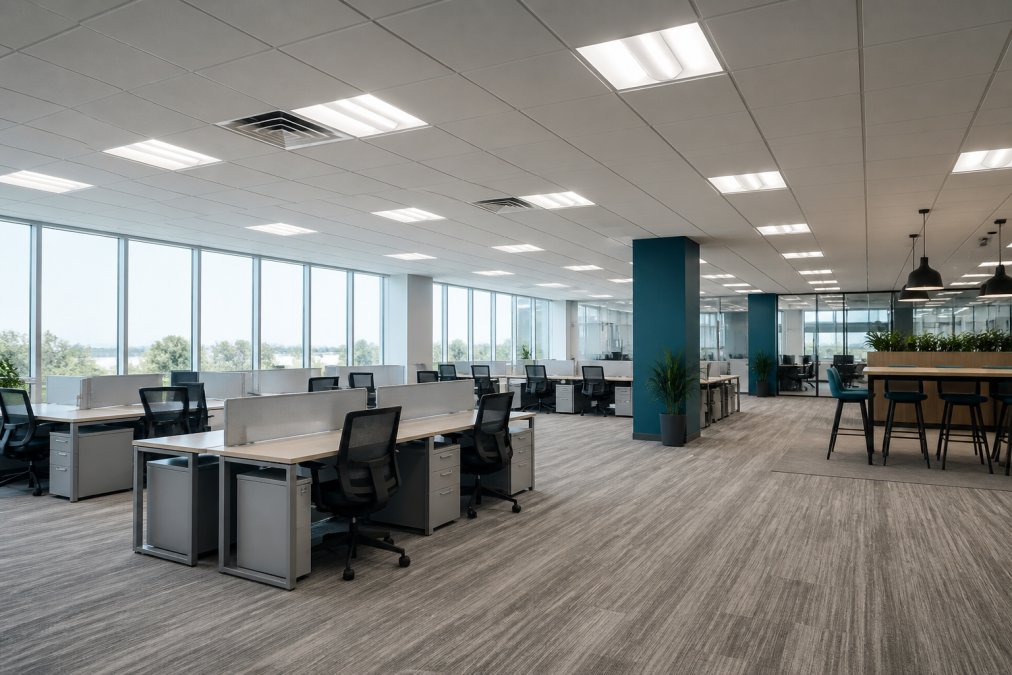
When it comes to selecting the best LED lighting for commercial offices, the choice between panel lights, troffers, and linear systems depends on your ceiling type, aesthetic preferences, and control requirements. Below are the top-performing fixtures that deliver reliability, efficiency, and employee comfort.
1. Alberta LED Lights & Electrical Supplies, Complete Commercial LED Solutions
At Alberta LED Lights & Electrical Supplies, we specialize in LED lighting and electrical components specifically designed for commercial environments. Our curated inventory includes premium fixtures from trusted manufacturers, ensuring you access professional-grade solutions that meet your project requirements with genuine efficiency.
What sets Alberta LED Lights & Electrical Supplies apart is our local presence in Calgary combined with our expertise in commercial LED retrofits. We stock CSA-listed components and can guarantee same-day pickup for urgent projects, a critical advantage when timelines are tight. Our team understands the real challenges contractors and facility managers face: finding reliable inventory, avoiding backlogs, and getting fixtures that actually perform as specified.
We carry a range of leading LED fixtures including troffers, panel lights, and linear systems from manufacturers like Votatec, Cree Lighting, and others. Rather than pushing a single product line, we help you select the right solution for your specific space, whether that's a 2x4 troffer for a suspended ceiling retrofit, a linear system for modern open-plan offices, or integrated smart lighting controls for larger facilities.
2. LEDCO LED Panel Lights, Best for Suspended Ceiling Retrofits
LEDCO LED Panel Lights are purpose-built for drop ceilings, offering straightforward installation into existing T-bar grids. Their 2x2 and 2x4 foot formats fit standard ceiling systems without modification, making them ideal for office retrofits where you want minimal disruption.
The uniform, glare-free illumination at 4000K promotes sustained focus for office tasks. LEDCO fixtures include optional 0-10V dimming, allowing integration with automated control systems for energy management. Energy consumption is 60-70% lower than equivalent T8 fluorescents, delivering measurable cost savings over the fixture's lifespan.
What works: Easy drop-in installation, proven performance in thousands of offices, energy savings that pay back the investment within 3-5 years.
What doesn't: These are designed specifically for suspended ceilings, so they're not suitable for drywall or exposed ceiling installations. If your office has a different ceiling type, you'll need an alternative approach.
3. Votatec 2x4 LED Troffer, Best for Flexible, Glare-Controlled Lighting
Votatec troffers directly replace 2-lamp T8 fluorescents in standard T-bar grids, offering field-selectable wattage and color temperature. This flexibility is a genuine advantage: you can configure each fixture for its zone without inventory complexity or rewiring.
The UGR <19 diffuser design specifically minimizes glare on computer screens, critical for any office with significant screen time. Votatec fixtures are CSA certified, meeting Canadian safety and performance standards. The selectable CCT (color correlated temperature) range from 3000K to 6000K means you can optimize lighting for different areas: cooler tones for task-intensive zones, warmer tones for break areas.
What works: Field-selectable parameters reduce inventory needs and installation time. The glare control is measurable and noticeable to employees working at desks.
What doesn't: Like most troffers, Votatec is optimized for grid ceilings. For other ceiling types, you'll need a different fixture category.
4. Satco 65-1665 2x4 White LED Panel, Best for Energy Rebates and Efficiency
Satco's 2x4 panel from Lumenco combines selectable wattage and color temperature with DLC Premium certification, qualifying for utility rebates in many regions. This certification matters: it's third-party verification that the fixture meets strict efficiency standards, and many utilities reward this with rebates that reduce your net cost.
The 3500K to 6500K color temperature range provides flexibility for different office zones. DLC Premium status also signals to energy auditors and facility managers that you've chosen a genuinely efficient solution, not just a cheap LED substitute.
What works: Rebate eligibility can offset 20-30% of fixture costs depending on your utility provider. High energy efficiency reduces operating expenses over time.
What doesn't: You'll need to verify rebate eligibility with your specific utility before purchasing. Rebate programs vary by region and change annually.
5. Cree Lighting Indoor Troffers, Best for Smart Controls and Long Lifespan
Cree Lighting troffers are built for facilities that want integrated smart controls. Their dimmable and intelligent lighting options (SmartCast, Lutron compatibility) allow centralized management of lighting across large offices, supporting automated schedules, occupancy-based dimming, and daylight harvesting.
The lifespan of 50,000 to 100,000 hours means fewer replacements and lower maintenance costs over 10-15 years. Cree fixtures support both 120-277V and 347V input, covering the voltage requirements of most Canadian commercial buildings.
What works: Smart controls reduce energy waste in large facilities. Long lifespan minimizes maintenance disruptions and labor costs.
What doesn't: Intelligent control systems require initial setup and may need a controls contractor for proper configuration. The upfront cost is higher than basic fixtures, so ROI depends on facility size and usage patterns.
6. Polarix Advanced LED Panels, Best for High Efficiency and Flicker-Free Lighting
Polarix panels deliver 110 lumens per watt, among the highest efficiency ratings in commercial LED fixtures. Adjustable power consumption (40-60W for 2x4 size) and customizable color temperatures (2200K, 3300K, 4400K) provide flexibility for different zones and aesthetic preferences.
The flicker-free design prevents eye strain during extended work hours, a genuine advantage for employees spending 8+ hours at desks. Up to 50,000 hours of lifespan keeps replacement frequency low.
What works: High lumen efficiency translates directly to lower energy bills. Flicker-free operation reduces fatigue and supports productivity.
What doesn't: The color temperature range maxes out at 4400K, which is cooler than some standard office preferences (4000K or 5000K). If you need daylight white (5000K+), this may not be your first choice.
7. Liteline STRIPE Linear System, Best for Modern Open-Plan Offices
Liteline's linear system enables seamless runs up to 45 meters (150 feet), creating a clean, continuous aesthetic suited to contemporary office design. The plug-and-play installation simplifies setup for long runs, and the system is manufactured in Canada, supporting local supply chains.
Linear lighting works exceptionally well in open-plan offices, collaborative spaces, and modern reception areas where a unified lighting design enhances the visual environment.
What works: Unbroken light lines create a premium aesthetic. Long runs reduce the number of separate fixtures and connection points.
What doesn't: Linear systems are specialized solutions. You'll likely need complementary task lighting or recessed fixtures for specific zones. Lineline is not a complete office lighting solution on its own, it's best paired with other fixture types.
Key Features to Evaluate When Choosing Office LED Lighting
When comparing LED fixtures for your commercial office, focus on these measurable attributes rather than brand reputation alone. Real performance differences emerge when you evaluate specs systematically.
Color Temperature and CRI (Color Rendering Index): Confirm the fixture offers your required color temperature, 4000K or 5000K for most offices. CRI measures how accurately the light renders colors; aim for CRI 90 or higher to ensure colors appear true (important for design work, quality control, or any task where color accuracy matters).
Lumen Output and Foot-Candle Delivery: Calculate expected foot-candles at your ceiling height and fixture spacing. A 4000-lumen fixture at 2.7 meters (9 feet) delivers roughly 40-50 foot-candles in a typical office layout. Verify this matches your task requirements, don't rely on wattage alone.
Glare Control (UGR Rating): Unified Glare Rating measures discomfort glare from the fixture. UGR <19 is suitable for office work; UGR <16 is optimal for computer-intensive tasks. This is not marketing language, it's a measurable optical property that directly affects employee comfort.
Dimmability and Control Options: 0-10V dimming or DALI controls allow integration with automated systems, supporting occupancy-based dimming and energy schedules. This flexibility reduces energy waste in spaces with variable occupancy.
Lifespan and Maintenance: 50,000-hour lifespan means fewer replacements over 10-15 years. Long-life fixtures reduce labor costs and operational disruptions from maintenance.
CSA Certification: All fixtures used in Canadian commercial installations must be CSA listed. Verify this before purchasing, non-certified equipment creates liability and may void insurance coverage.
| Feature | Why It Matters | What to Look For |
|---|---|---|
| Color Temperature | Affects alertness and comfort | 4000K or 5000K for offices |
| Lumen Output | Determines actual illumination level | 3000-4500 lumens for 2x4 troffers |
| UGR Rating | Controls glare on screens | <19 for general office, <16 for computer work |
| Dimmability | Enables energy-saving automation | 0-10V or DALI compatible |
| Lifespan | Reduces maintenance frequency | 50,000+ hours preferred |
| CSA Certification | Meets Canadian safety standards | Non-negotiable for commercial use |
Commercial LED Lighting Return Policy and Warranty Considerations
Before committing to a large LED retrofit, understand the return and warranty terms. Different manufacturers and distributors offer varying protections, and these details matter when you're investing in hundreds or thousands of fixtures.
Most commercial LED fixtures come with manufacturer warranties covering defects in materials and workmanship, typically 5-10 years for premium brands. This covers premature failure due to manufacturing flaws, not damage from installation errors or environmental stress.
Return policies vary significantly. Some distributors allow returns within 30 days if fixtures are unopened and undamaged; others restrict returns to defective units only. When sourcing through Alberta LED Lights & Electrical Supplies, verify the specific return window and condition requirements before purchase. This is especially important for large orders where a single defective batch could delay your project.
For commercial projects, request documentation of the warranty terms in writing. Some manufacturers exclude certain failure modes (e.g., cosmetic damage, discoloration) from coverage. Understanding these limits prevents disputes later if fixtures fail.
One often-overlooked detail: confirm whether the warranty is transferable if the building changes ownership. For leased commercial spaces, this matters less, but for owner-occupied facilities, a transferable warranty adds resale value.
Installation and Retrofit Options for Office Spaces
LED retrofit projects range from straightforward (replacing fixtures in existing grids) to complex (rewiring for new fixture types). Understanding your options prevents costly mistakes and project delays. Equally important is ensuring your retrofit complies with Canadian building codes and energy standards, which many facility managers overlook until an inspection reveals violations.
Grid Ceiling Retrofits (Easiest)
If your office has a suspended T-bar ceiling, retrofitting is simple. LEDCO, Votatec, and Satco fixtures drop directly into existing grids without modification. Installation takes minutes per fixture, and you can phase the retrofit over time, replacing fixtures as budgets allow. This approach minimizes disruption and spreads costs.
Grid retrofits are also the fastest path to code compliance. Since you are replacing like-for-like (fixture for fixture in the same location), electrical circuits typically do not require modification. However, verify with your electrician that the existing wiring and breakers can safely handle LED loads. LEDs draw 40-60% less power than fluorescents, so you will almost never need to upgrade service panels, but circuit verification is still required for insurance and inspection purposes.
Drywall/Popcorn Ceiling Installations
If you have drywall or popcorn ceilings, you will need recessed fixtures or surface-mounted options. Cree Lighting troffers work well here, as do linear systems like Liteline. Installation requires opening the ceiling and running electrical, making it more invasive and expensive than grid retrofits.
Drywall installations trigger additional code requirements. In most Canadian provinces, any new electrical work must be performed by a licensed electrician and inspected by a qualified electrical inspector. This is not optional, it is a requirement under provincial electrical safety codes (such as the Ontario Electrical Safety Code or equivalent in your province) and is enforced by your local authority having jurisdiction (AHJ).
When planning drywall installations, budget for:
- Licensed electrician labor (typically $50-150 per hour depending on region and complexity)
- Electrical inspection fees (varies by municipality, typically $100-300)
- Ceiling repair and finishing (if you are opening existing drywall)
- Potential asbestos abatement (if your building was constructed before 1980 and contains popcorn ceilings)
Asbestos is a critical compliance issue. Popcorn ceilings installed before 1980 often contain asbestos. Disturbing asbestos-containing materials without proper abatement is illegal under Canadian environmental regulations and creates serious health and liability risks. Before opening any popcorn ceiling, have it tested by a certified lab. If asbestos is present, hire a licensed abatement contractor, do not attempt removal yourself.
Exposed/Beam Ceilings
Modern offices with exposed beams or architectural ceilings benefit from surface-mounted or pendant fixtures. Axis Lighting and Liteline linear systems excel in these settings, creating a design-forward aesthetic while delivering proper illumination.
Exposed ceiling installations often have fewer code constraints because fixtures are visible and accessible, simplifying inspection. However, ensure all electrical connections are made in accessible junction boxes and that wiring is properly supported and protected. Exposed wiring must meet the same safety standards as concealed wiring, visibility does not exempt it from code.
Phased vs. Complete Retrofit
Large offices often phase retrofits by zone or floor. This spreads costs, minimizes operational disruption, and lets you test fixtures in smaller areas before committing to the entire space. Phased approaches also allow you to adjust based on employee feedback; if a color temperature does not feel right, you can adjust subsequent phases.
Phased retrofits require careful documentation. Keep records of which fixtures were installed when, their specifications, and any modifications made to electrical systems. This documentation is essential for warranty claims, insurance purposes, and future facility audits.
Canadian Building Code and Energy Code Compliance
All commercial LED lighting installations must comply with the National Building Code of Canada (NBC) and applicable provincial building codes. Key compliance areas include:
Illumination Levels: The NBC references standards from the Illuminating Engineering Society (IES) and ASHRAE (American Society of Heating, Refrigerating and Air-Conditioning Engineers) for minimum illumination levels. For commercial offices, the standard is 300-500 lux (approximately 30-50 foot-candles) depending on the task. General office work typically requires 400-500 lux (40-50 foot-candles); detailed visual tasks (design work, quality control) may require 500-750 lux (50-75 foot-candles). Your retrofit must deliver these levels across the entire space, not just near windows or in isolated zones.
Energy Efficiency: Most provinces have adopted energy codes based on the Model National Energy Code for Buildings (MNECB). These codes set minimum efficiency standards for lighting systems. LED fixtures must meet or exceed these standards, which typically require:
- Minimum efficacy (lumens per watt) based on fixture type
- Automatic controls for spaces with variable occupancy (occupancy sensors, daylight harvesting)
- Dimming capability for spaces larger than a certain threshold
For example, in Ontario, the Ontario Building Code (OBC) requires that lighting systems in commercial buildings include automatic controls to reduce energy consumption during unoccupied periods. This means your retrofit should include occupancy sensors or automated scheduling, not just efficient fixtures.
Electrical Safety: All electrical work must comply with the Canadian Electrical Code (CEC), administered through provincial electrical safety authorities. The CEC requires:
- All fixtures must be CSA-certified (Canadian Standards Association)
- All electrical connections must be made by licensed electricians
- All new circuits and modifications must be inspected by a qualified electrical inspector
- Grounding and bonding must meet CEC standards
- Emergency lighting (if required) must remain functional and be tested regularly
Non-compliance with the CEC can result in fines, insurance denial, and liability if an electrical failure causes injury or property damage.
Glare and Visual Comfort: The NBC also references IES standards for glare control. Commercial office lighting should have a Unified Glare Rating (UGR) of less than 19; computer-intensive tasks should have UGR <16. This is not a suggestion, it is a code requirement in many provinces. Fixtures that do not meet these standards may fail inspection.
Working with Qualified Installers and Inspectors
For commercial projects, hire a licensed electrician familiar with LED systems and current building codes. Proper installation ensures fixtures perform as rated, warranty coverage remains valid, and your facility passes inspection.
Before installation begins, confirm with your local AHJ (authority having jurisdiction) whether your retrofit requires a building permit. Many provinces require permits for any electrical work in commercial buildings, even if it is a simple fixture replacement. Permits cost $50-300 but are non-negotiable, skipping permits can result in fines and difficulty selling or refinancing the building.
After installation, request a Certificate of Compliance from your electrician and a signed-off inspection report from the electrical inspector. Keep these documents for your records; they prove that your installation meets code and are essential for insurance claims or future audits.
Alberta LED Lights & Electrical Supplies can connect you with qualified installers in Calgary who understand commercial LED retrofits and current code requirements. A professional installer will handle permitting, inspection coordination, and code compliance, protecting your investment and your facility.
Energy Efficiency and Cost Savings with LED Office Lighting
LED fixtures reduce energy consumption by 60-75% compared to fluorescent or incandescent alternatives (U.S. Department of Energy). For a 10,000 square foot office with 100 fixtures running 12 hours daily, switching to LEDs can reduce annual electricity costs by thousands of dollars.
The math is straightforward: a fluorescent 2x4 troffer draws 110-150W; an equivalent LED draws 40-60W. Over 12 hours daily for 250 working days annually, that's a difference of 2,500-2,750 kWh per fixture per year. At typical commercial rates, that's $250-350 in annual savings per fixture.
For 100 fixtures, that's $25,000-35,000 in annual energy savings. Even accounting for the higher upfront cost of LED fixtures, the payback period is typically 3-5 years, after which you're operating on pure savings.
Additional cost reductions come from maintenance. LEDs last 50,000+ hours versus 20,000 hours for fluorescents. Fewer replacements mean lower labor costs and less operational disruption. Over a 10-year period, maintenance savings often exceed the energy savings.
Some utilities offer rebates for LED retrofits, especially for fixtures with DLC Premium certification. These rebates can offset 20-30% of fixture costs, accelerating payback. Check with your local utility to see what programs are available.
Automated controls amplify savings further. Occupancy-based dimming, daylight harvesting, and scheduled dimming can reduce energy consumption by an additional 15-30% depending on building usage patterns. Cree Lighting fixtures with smart controls are particularly effective in facilities with variable occupancy.
Conclusion
The best LED lighting for commercial offices balances color temperature, illumination levels, glare control, and long-term reliability. For most businesses, 4000K or 5000K fixtures delivering 400-500 lux (40-50 foot-candles) with UGR <19 glare control create an environment where employees stay focused and productive.
Specific fixture choices depend on your ceiling type and control requirements. Grid ceiling retrofits favor troffers like those from Votatec or LEDCO; modern open-plan spaces benefit from linear systems like Liteline; facilities prioritizing smart controls should consider Cree Lighting's integrated solutions.
When you're ready to source LED fixtures for your commercial retrofit, Alberta LED Lights & Electrical Supplies provides professional-grade lighting and electrical components designed for commercial projects. We stock CSA-listed fixtures from trusted manufacturers, guarantee same-day pickup for urgent orders, and connect you with qualified installers in Calgary. Get started with a consultation to select the right lighting solution for your space and unlock the energy savings and productivity gains that proper commercial LED lighting delivers.
Frequently Asked Questions
What are the best LED lights for an office?
The best LED lights for commercial offices depend on your ceiling type and lighting goals. LED troffers like the Votatec 2x4 work well in suspended grid ceilings and offer glare-free illumination with UGR <19 ratings. Panel lights such as LEDCO and Satco fixtures provide uniform light at 4000K, ideal for sustained focus. Linear systems like Liteline STRIPE suit modern open-plan spaces. Choose based on your existing ceiling infrastructure, desired color temperature, and lumen output requirements for your specific tasks.
How many lumens per square foot does an office need?
Office lighting lumen requirements typically range from 30 to 50 lumens per square foot, depending on the task. General office areas and hallways need approximately 30-40 foot-candles (320-430 lumens per square meter). Detailed work areas such as drafting rooms or inspection stations require 50-100 foot-candles. Meeting rooms and collaborative spaces benefit from 30-50 foot-candles. Always verify your specific space's requirements based on the type of work performed and local building codes to ensure adequate visibility and productivity.
Is 3500K or 4000K better for office productivity?
The best color temperature for office productivity is 4000K for most general office work. This neutral white light promotes alertness and focus during extended screen time, making it ideal for computer-based tasks. Some offices use 3500K for a slightly warmer tone that can feel less clinical while still supporting concentration. For spaces with high visual demands, 5000K (daylight white) offers maximum clarity. The choice depends on your office culture and task type, cooler temperatures (4000K-5000K) enhance alertness, while slightly warmer tones (3500K) create a more relaxed atmosphere.
What should I know about commercial LED lighting return policies?
When purchasing commercial LED lighting fixtures, review the return policy before committing to bulk orders. Check whether the supplier accepts returns within 30 days, whether restocking fees apply, and if fixtures must be unopened or in original condition. Some commercial LED lighting return policies vary by fixture type, standard panels may have different terms than custom or special-order items. Verify CSA certification and warranty coverage (typically 3-5 years for commercial fixtures) separately from return eligibility. Always confirm stock availability and lead times with your supplier to avoid delays.